
From Script to Screen
Development and Production Breakdown and Reflections

1. Introduction: Purpose
Rather than being a step-by-step guide on how to write a script. It is aimed at aspiring filmmakers, scriptwriters, and film students and can be viewed as a useful guide to making your own short film, this article is written with the purpose of giving some insight into the development, pre-production, and production of short films after the script has been completed (including rewrites following feedback and notes). I’ve used my own writing and films as case studies, and having recently produced a short film for the first time. Which taught me a lot about the process that I didn’t learn in film school.
2. Writing Style and Early Development
2.1 Scenario-Driven Writing
My writing process, particularly for short scripts, has always been about creating a scenario or situation and building on that to tell a story. The goal of a short film is to demonstrate skill. For a writer, that means telling a complete story — beginning, middle and end — within a limited timeframe. I usually aim to write scripts that are under 10 pages, though as you will learn, page count and runtime are never exact due to many factors. From the short films I’ve watched, it seems a lot of aspiring screenwriters, writer-directors and film students try to cram feature film narratives into a short film, the short answer is that you can’t tell a 90–120-minute story in 10-15 minutes. Think smaller. Damien Chazelle took a single sequence from his feature script for Whiplash and produced it as a proof of concept. The short stands alone, while demonstrating the viability of the feature.
2.2 Evolution of Style: From Tattoo to Later Work
Comparing my early work such as ‘Tattoo’, my first produced short, to more recent shorts like ‘Stalled’ and ‘Screw You’ shows a clear stylistic shift toward concise visual writing on the page, with single sentences often replacing full descriptive paragraphs as demonstrated below in the opening scene excerpts as written for each film:
TATTOO
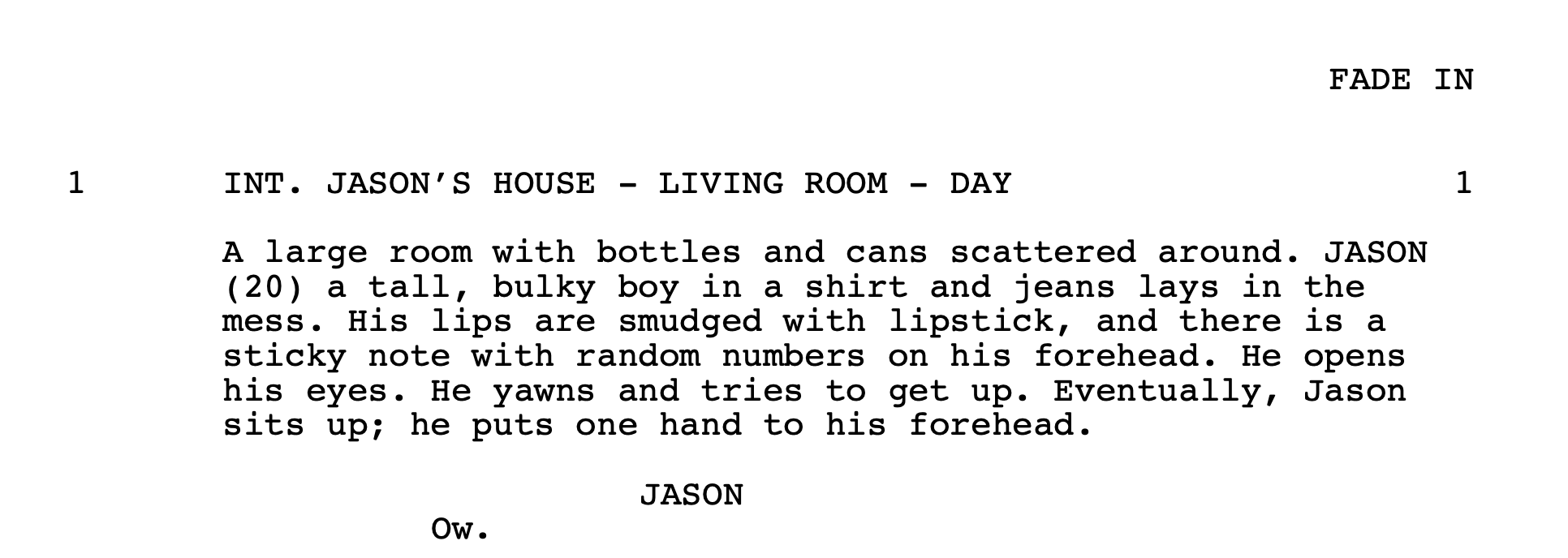
I should clarify that I wrote Tattoo whilst at university (the script got noticed after I posted it online), and I’ve learned a lot more about screenwriting since then, particularly from doing coverage which requires a lot of script reading. Rereading it now, along with the rest of the script, I would say it’s overwritten and could be condensed into single lines.
Watch it here—
STALLED

SCREW YOU

The shooting script for Screw You (below) changed it, so the film starts outside, but the scene is virtually the same.
3. Learning Through Reading Scripts
The work of writer-director Walter Hill—whose pages are clean and straightforward—has influenced my own minimalist style.
Some of his scripts can be found here—https://bulletproofscreenwriting.tv/walter-hill-screenplays-download/
Reading scripts—especially alongside watching the film—is one of the most valuable learning tools available to writers. This is particularly relevant when writing genre scripts, such as horror, sci-fi, action, thrillers. The way the script appears on the page often reflects how the film will look on screen.
A script is written to be made into something else, not simply read like a novel. Budget, location, scheduling, and interpretation will inevitably shape how it appears on screen.
4. Collaboration and the Writer’s Role
In my opinion, it is the writer’s script until cast and crew come on board. After that, it becomes a collaborative document. Dialogue changes during rehearsals, directors, DPs and actors, along with everyone who reads the script will interpret it differently. Similarly, practical constraints such as budget, location and shooting schedule will require rewrites. When reshoots are not possible, creative problem-solving, for example—voiceovers, text inserts, editorial adjustments can resolve problems.
5. Case Study I: Stalled
5.1 Concept and Containment
‘Stalled’ began as a contained idea: a man trapped in a toilet stall with a dead body next door. The challenge was sustaining tension whilst utilizing the confined space.
5.2 Script Evolution and Character Development
Early drafts focused on fewer characters. Later revisions, including the decision to make the gangsters a family, deepened conflict and added emotional stakes. Reshoots further reshaped character dynamics.
5.3 Production Adjustments
Actor availability issues shifted narrative emphasis. The lead actor was unavailable, so the story was shifted to focus on the villainous gangsters, giving them more depth. Practical decisions—such as moving scenes into the pub interior—ultimately improved the film’s structure.
The film as available here—
6. Case Study II: Screw You
6.1 Original Concept
Initially conceived as a one-location crime short involving a double-cross, ‘Screw You’ evolved significantly over time.
6.2 Emergence of the Femme Fatale
Influenced by noir and pulp fiction, Kyra was introduced as a femme fatale figure and later reshaped into a calculating anti-heroine. Making Cece an onscreen character added emotional motivation and expanded the story’s scope.
6.3 Increasing Conflict and Stakes
Adjustments were made to balance power dynamics and heighten tension, ensuring clear audience alignment and narrative drive.
7. Self-Financing and Producing
Frustrated by stalled development and difficulty finding collaborators, I chose to self-finance in order to get the film made. I was able to put together a modest £5,000 budget which covered cast, crew, props, location catering, insurance and ensured professionalism and commitment. The final budget came to £5,500 when accounting for post. And I’ve been told by producers that only going 10% over is pretty good.
Budget constraints influenced logistical decisions, including crew selection, scheduling, and location management.
8. Practical Lessons in Production
Producing required negotiating fees, managing travel and accommodation, securing insurance, and handling contracts—areas rarely emphasised in film school.
Self-financing provided creative control but significantly increased responsibility and stress.
9. The Shooting Script vs The Original Draft
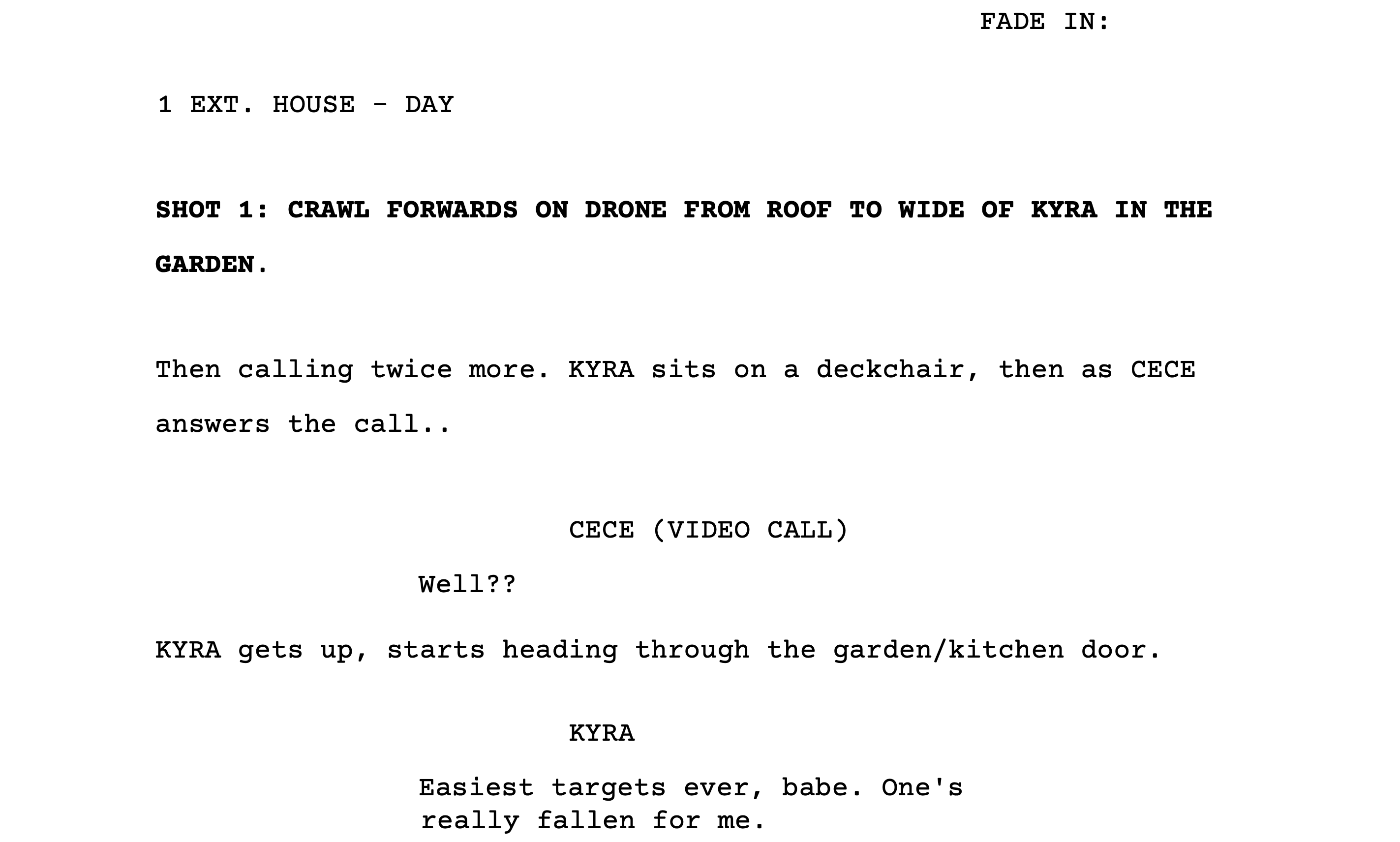
The shooting script—with scene numbers, camera direction, and technical instructions—became the true production blueprint. The seven-page script expanded considerably during this stage into a 13-page shooting script, demonstrating how page count does not directly equal runtime. Below is the opening sequence of the shooting script, written by the director.
10. Casting and Authority
Producing required difficult decisions, including casting choices and balancing
creative input. Greater involvement provided insight into leadership responsibilities beyond writing. In hindsight, I should have pushed for casting the actors whose auditions I preferred and solved certain logistical issues earlier to reduce the impact on location booking and scheduling.
11. Final Reflections: Why Getting It Made Matters
Producing is demanding but ensures the film exists. A completed short film—even one made under financial and logistical strain—is more valuable to a career than an unproduced script.
Writing improves craft, but making films builds careers and makes you stand out. In a landscape that increasingly favours proven track records over potential, independent production is becoming less of a choice and more of a necessity. Whilst none of this is easy, having a film that demonstrates your abilities is more beneficial than piles of unproduced scripts.
At the time of writing, Screw You has over 34,000 views on YouTube — tangible proof that independently produced work can find an audience.
Film available here—